Armstrong kidnapping case
The Armstrong kidnapping case is the foundational tragedy of Murder on the Orient Express, a crime so devastating that it shatters an entire family and, years later, assembles a jury of twelve ordinary people to carry out an execution on the snowbound Orient Express. The case is the moral and emotional engine of the plot, transforming a detective novel into a meditation on justice, vengeance, and the limits of the law.
The Crime and Its Victims
Colonel Armstrong, an Englishman who had won the Victoria Cross, was half American through his mother, a daughter of Wall Street millionaire W. K. Van der Halt. He married Sonia Armstrong, the daughter of Linda Arden, the most famous tragic American actress of her day. They lived in America and had one child, a girl named Daisy, whom they idolized. When Daisy was three years old, she was kidnapped, and an impossibly high ransom was demanded. After the parents paid the enormous sum of two hundred thousand dollars, the child's dead body was discovered; it had been dead for at least a fortnight. Public indignation rose to fever pitch. Worse followed: Mrs. Armstrong, who was expecting another baby, gave birth prematurely to a dead child following the shock of the discovery, and she herself died. Her broken-hearted husband shot himself. The tragedy also claimed a fourth victim: a French or Swiss nursemaid named Susanne. The police were convinced she had some knowledge of the crime and refused to believe her hysterical denials. In a fit of despair, the poor girl threw herself from a window and was killed. It was proved afterwards that she had been absolutely innocent of any complicity in the crime.
The Escape of Justice
About six months after the kidnapping, a man named Cassetti was arrested as the head of the gang. The gang had used the same methods in the past: if the police seemed likely to get on their trail, they killed their prisoner, hid the body, and continued to extract as much money as possible before the crime was discovered. Cassetti was the man. But by means of the enormous wealth he had piled up, and owing to the secret hold he had over various persons, he was acquitted on some technical inaccuracy. He would have been lynched by the populace had he not been clever enough to give them the slip. He changed his name to Samuel Edward Ratchett and left America, living as a gentleman of leisure, travelling abroad and living on his rents. The novel's detective, Hercule Poirot, discovers this identity when he reconstructs a charred fragment of a letter found in Ratchett's compartment, which reads "member little Daisy Armstrong."
The Conspirators and Their Motives
The Armstrong case directly or indirectly connects nearly every passenger in the Stamboul-Calais coach. Linda Arden, the actress and mother of Sonia Armstrong, is on the train disguised as the American Mrs. Hubbard. Countess Andrenyi is Helena Goldenberg, Sonia's younger sister. Mary Debenham was the governess in the Armstrong household. Greta Ohlsson was Daisy's nurse. Antonio Foscarelli was the family chauffeur. Edward Masterman was Colonel Armstrong's batman in the war and later his valet. Pierre Michel, the Wagon Lit conductor, is the father of Susanne, the nursemaid who committed suicide. Colonel Arbuthnot was Colonel Armstrong's best friend. Hector MacQueen's father was the district attorney who handled the case. Princess Dragomiroff was Sonia Armstrong's godmother. Cyrus Hardman, a private detective, had been in love with Susanne. Each of these twelve people, united by grief and a sense of injustice, decided that the sentence of death that Cassetti had escaped had to be carried out. They planned the murder over a long period, tracking Ratchett down, infiltrating his employment, and staging the crime on the Orient Express, where Pierre Michel worked. The plan was for each of them to stab Ratchett once, so that no single person would know which blow actually killed him, and to create a web of alibis that would make the case impossible to solve.
Consequences and Aftermath
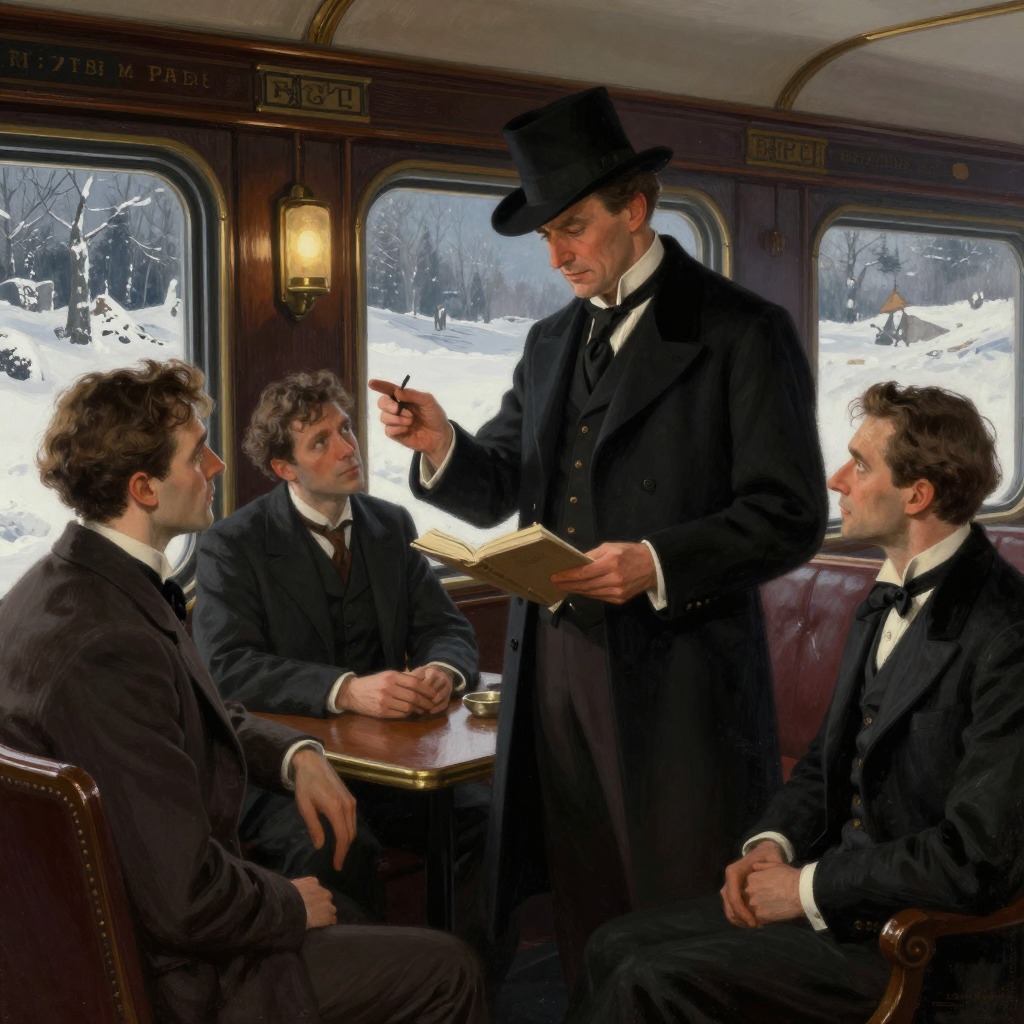
The snowdrift that stops the train forces the conspirators to improvise, but their plan holds. Poirot, after hearing all the evidence, presents two solutions to the assembled passengers. The first is a conventional explanation involving an outside assassin. The second, which he reveals as the truth, is that all twelve passengers—a self-appointed jury—carried out the execution. M. Bouc, a director of the Compagnie Internationale des Wagons Lits, and Dr. Constantine agree to accept the first solution as the official one to present to the Jugo-Slavian police, allowing the conspirators to go free. The Armstrong kidnapping case thus becomes the moral justification for a private act of justice that the legal system had failed to deliver.